

Ever notice how some kids seem to freeze the moment you ask them to add three numbers instead of two? Kids who can quickly solve 5 + 3 suddenly look at 5 + 3 + 2 like it’s an impossible riddle!
It’s such a normal reaction. Adding three numbers is a new leap for them. But it’s also one of those essential skills that sets the stage for more advanced math down the road. It builds mental math flexibility, prepares them for regrouping in double-digit addition, and is right there in our first-grade standards.

The good news? It doesn’t have to be stressful for you or your students. With the right strategies and tools, adding three numbers can become another routine part of your math block. Today, let’s look at why this skill matters, some simple teaching strategies that really work, ways to support struggling students, and a few ideas to keep practice engaging. And if you’re short on planning time {hello, who isn’t?} I’ll share an easy, no-prep resource that’s saved me more than once.
Why Adding Three Numbers Matters
Adding three numbers isn’t just busywork. It’s the foundation of so many future skills. When students learn to see number combinations and make flexible choices about how to add, they’re building real mental math fluency.
This kind of thinking prepares them for regrouping when they move to two-digit addition. It also helps them develop confidence with numbers, seeing addition not as a single path but as something they can approach in different ways. Plus, it’s right there in most first grade standards, which expect students to add within 20—even when there are three addends.
Helping students get comfortable with this step can make all of their future math work smoother.
Strategies That Work
One of my go-to strategies is Counting On. It’s straightforward and accessible for most students. Start with the biggest number in the problem, then count on the others one at a time. For example, with 4 + 3 + 2, you start at 4, count on 3 {getting to 7}, and then count on 2 more to land at 9. It’s slow and steady but builds accuracy.
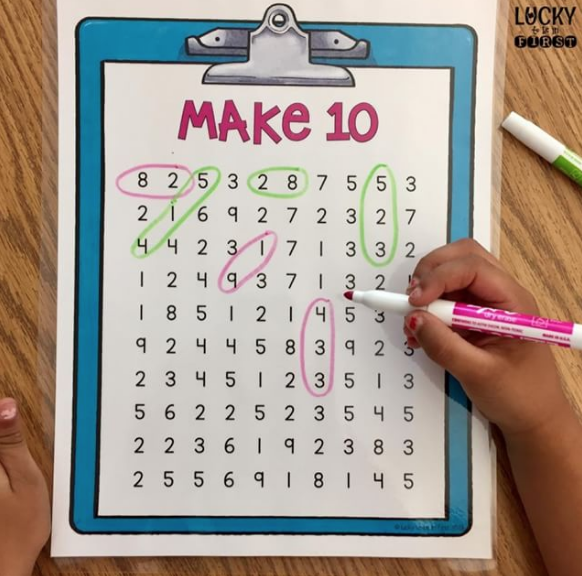
Another favorite is Making 10. This one teaches students to spot friendly number combinations. If they see 7 + 3 + 2, they can pair 7 and 3 to make 10 and then add 2 more to get 12. It’s a classic mental math move that strengthens their number sense in a big way.
One of my favorite videos for reinforcing this is from none other than Jack Hartmann 🙂
If you’re looking for a game to help master making 10, make sure to check out Circling Sums.
Not all students are ready to do this in their heads, so visual supports are a must. Ten frames are perfect for showing combinations that make 10. Number lines help students see jumps in sequence. Counters and manipulatives give them something tangible to hold and move, making abstract ideas much more real.
I’ve found that using Math Meeting from the beginning of the year helps build this strong foundation for tens facts!

Hang strategy posters up after introducing each one to give students a chance to reference them.

Want me to send you this post?
Tips for Supporting Struggling Students
If you have students who get stuck, don’t worry…it’s normal! One easy approach is to break the problem into two steps. Have them add two of the numbers first, then add the third. Modeling this out loud is also incredibly effective. Talk through your thinking step by step so they can hear how you approach the problem.

Hands-on tools aren’t just for the beginning of the year. Keep those counters, cubes, and number lines available. They’re not “babyish”—they’re brain-friendly! Students need time and repetition to master these skills. Partner practice can also be helpful. Pair students strategically so they can help each other think it through.
Patience is key here. Sometimes students just need to see it a few different ways before it clicks.
Making Practice Engaging
Practice doesn’t have to mean rows of problems on a worksheet, {though we know that’s a necessary skill, too!} Mix things up to keep kids engaged.

Here are few ways to sneak in some fun practice:
- Math Centers – Set up dice-rolling games where students add three rolled numbers.
- Card Games – Draw 3 cards and add them up.
- Partner Challenges – Race to solve problems together.
- Math Meeting Problem of the Day – Make your problem of the day a 3-digit problem
When practice feels like play, students are much more likely to stick with it—even when it’s a little tricky.
Looking for a No-Prep Solution?
If you’re like me, you don’t always have time to make the perfect center or write out problems on the fly. That’s why I put together my Adding Three Numbers Pack.

This pack includes over 20 print-and-go pages designed specifically for first graders. It includes posters, a set of task cards, a game, and 8 printables to help master the skill!

The activities perfect for math centers, independent work, homework packets, or even those days you need to leave sub plans with minimal prep. Just print and teach.
If you want to check them out, you can find them right here.
What’s your favorite way to teach adding three numbers? Do you have a go-to activity, game, or strategy your students love? I’d love to hear about it in the comments!
Don’t forget to pin this post for later!

